





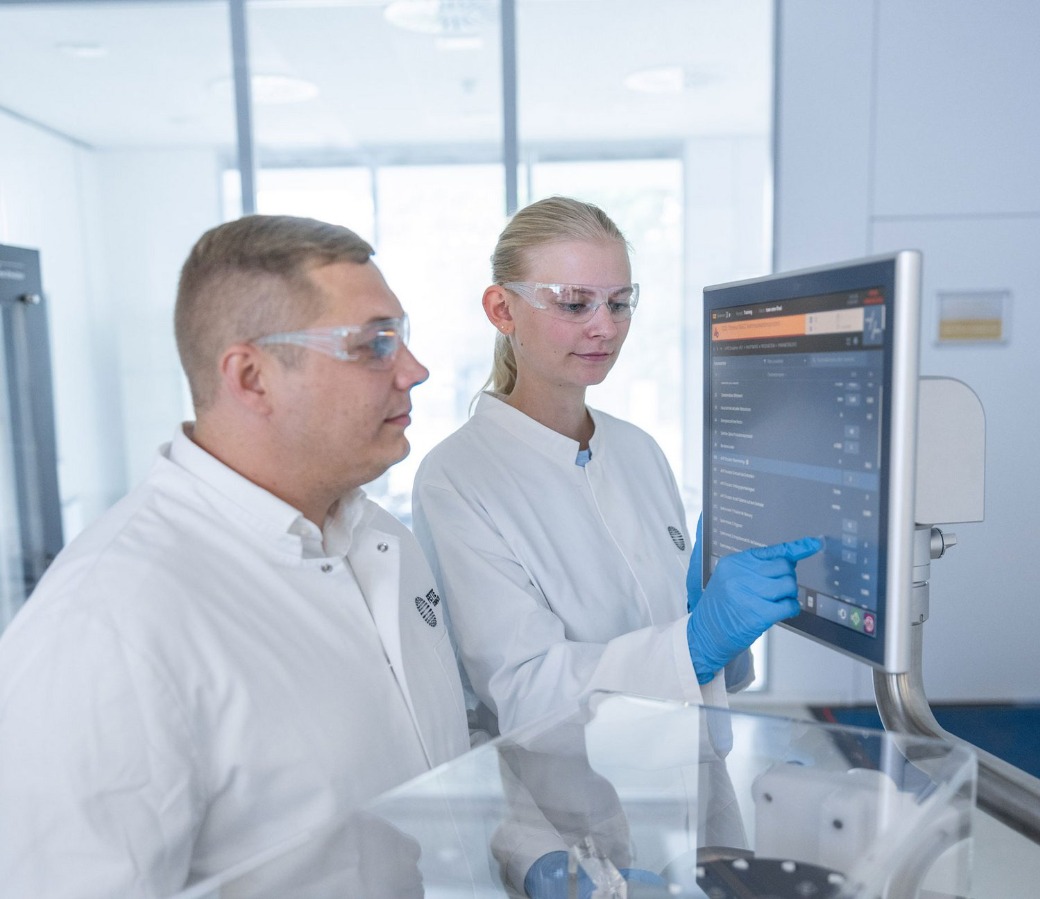
Dosing screws that suddenly behave differently. Near-infrared models that fail at full production speed. Blends that performed homogeneously in small batches but unexpectedly fall short at full scale. The transition from lab to production is full of pitfalls. Emulators help detect them early.
Process development traditionally moves through several scale-up stages, from laboratory trials and development systems to the production line. With every step, the influencing factors shift. Blending dynamics change with throughput, dosing parameters need to be readjusted, and measurement methods developed in the laboratory suddenly encounter different environmental conditions.
"Many scale-up problems arise simply because powder behavior under production conditions cannot be reliably predicted," explains Nicolas Ender, Group Lead Application Testing at Fette Compacting.
The limits of simulation
Software-based simulators do offer valuable insights into process behavior, but in practice they have clear limitations. Their underlying model assumptions can only approximate real material behavior such as flow properties, particle sizes, and compression characteristics.
Emulators take a fundamentally different approach: they physically replicate individual process units of the production line at identical scale. Whatever is developed on the emulator transfers directly to the production system. "The key point is this: we do not recalculate. We replicate. The emulator uses the same mechanics, sensors, and user interface as the later production system," Ender notes.
The right emulator for every step
Along the Continuous Direct Compression process chain, three specialized emulators come into play:
The FE CPS Process Emulator replicates the dosing process including the automatic refill system and loss-in-weight dosing. Dosing parameters, screw types, and refill strategies can be tested systematically. The results transfer directly to the FE CPS Continuous Processing System, which, together with a tablet press, forms a complete Continuous Direct Compression line.
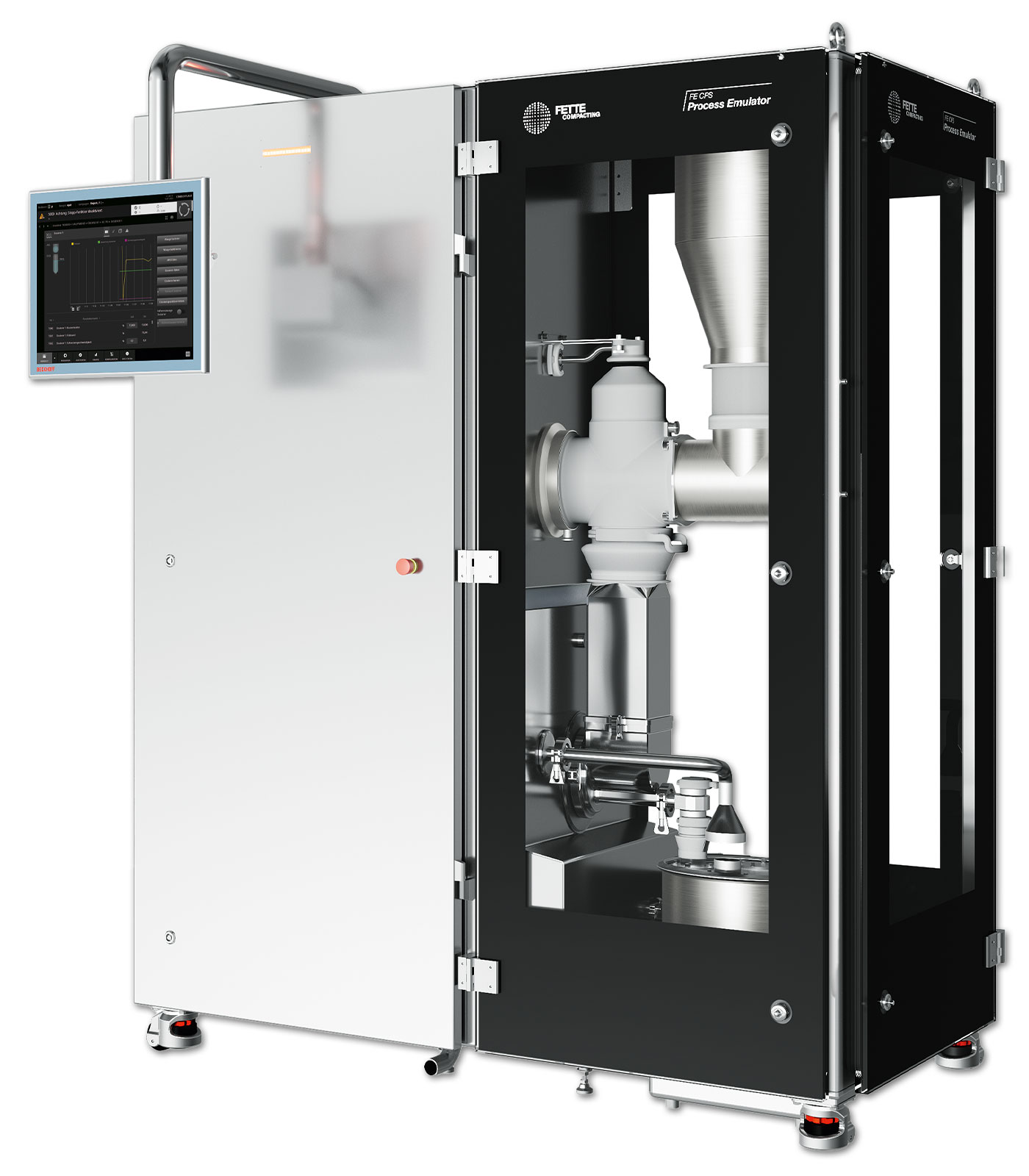
The FE CPS Process Emulator precisely replicates the dosing process of the FE CPS.
The ePAT Emulator focuses on process analytics. Tablets travel past the Tablet Uniformity sensor (TU sensor) on exactly the same motion path, and at exactly the same speed, as they will in the later production press. Drawing on near-infrared spectroscopy, the TU sensor checks tablet uniformity and active ingredient concentration. The emulator allows the sensor to be precisely calibrated even before production begins, laying the foundation for reliable in-line quality measurements.
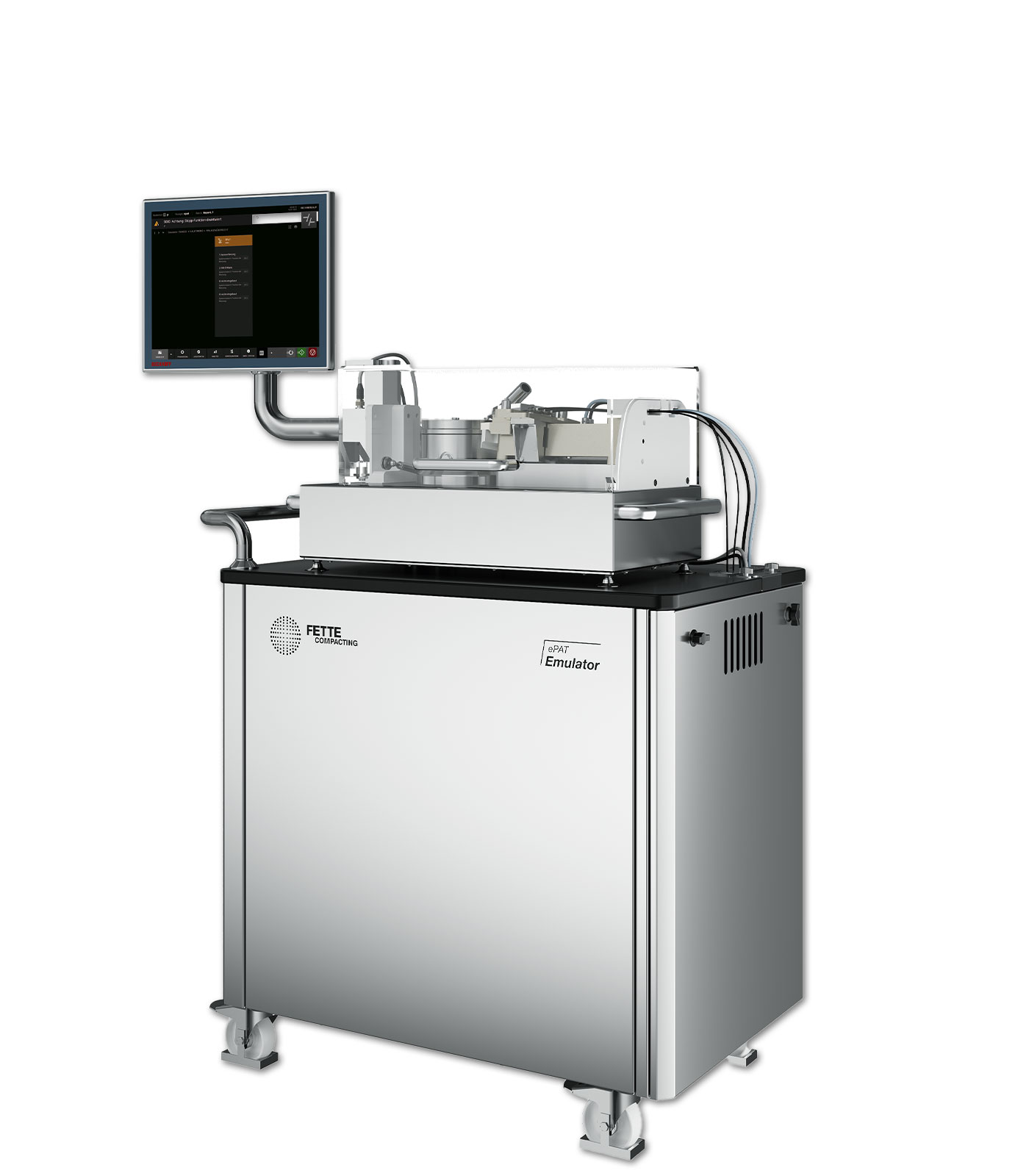
The ePAT Emulator provides the foundation for reliable in-line monitoring of Critical Quality Attributes.
The ePAT BU Emulator (BU stands for Blend Uniformity) replicates the powder dynamics inside the filling system of the tablet press. Methods for determining the active ingredient concentration and the uniform distribution of all ingredients can be developed and validated without requiring full tableting. In addition, the powder remains available for further analysis.
Emulators as an early warning system
For manufacturers, emulators deliver several advantages: development cycles shorten significantly, consumption of expensive active ingredients drops, and production systems stay free for commercial production. Failed technology transfers and unplanned production downtime can be avoided.
"Emulators are valuable far beyond development," says Ender. "A new raw material supplier, a slightly different particle size, an adjusted formulation and suddenly the powder behaves differently. With emulators, we can work through these scenarios in a targeted way without affecting ongoing production."
Process reliability right from the start
Ultimately, emulators reshape the development approach itself. A step-by-step scale-up with built-in uncertainties is replaced by integrated development under real conditions. Processes are engineered for production reality from the start. "Our goal is technology transfer without surprises. When the process runs on the production system for the first time, there should be no open questions left," says Ender.
